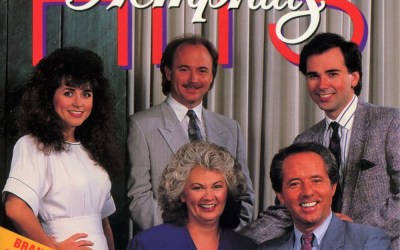
Go Rest High On That Mountain

Last night, my father, James Boreing, fell asleep on the living room couch (most likely watching Fox News or some Lifetime movie). This morning, he awoke in Glory.

Dad is my number one reason for my love of Southern Gospel music. I grew up on his record collection of Goodmans, Hinsons, Dixie Echoes, Kingsmen, and Oak Ridge Boys. He carted me around to just about any concert I wanted to go to, and was the biggest single influence on my life, both musically and spiritually.

This will be one of the hardest days of my life, but at the same time, it is also bringing me comfort in knowing that he is finally Home.

I love you, Dad. Enjoy your reward!!

Live vs “Live”

As a tag on my recent Recording Oddity, I am curious to know….how many readers have attended a live album and/or video recording? How different was the final product from the original performance? Were there songs or moments from the concert that you wish would’ve made the cut (or perhaps should have been omitted)?

I’m sure many of us have been to NQC at some point, which would technically qualify, but I’m talking more along the lines of a single artist/group specifically performing for the purpose of recording a live project of some sort, where they will have full control over what is sung and what is fixed later in a studio as needed.

The main reason for my curiosity is this: there are times on a live album where I am pretty sure I can locate the tweaks and tricks, and I want to see if anyone else may have caught similar instances. In particular, I’d like to know about the 80′s era live albums (Hinsons, Gold City, Kingsmen) before tracks became the preferred source of musical accompaniment. As I stated before, the Cathedrals’ Travelin’ Live album is a prime example of a “before” and “after,” in that the video appears to have little editing done compared to the LP. Same goes for their Campmeein’ “Live” (the quotes are not just in the title, but also all the liner notes, leading me to believe that they were fully aware of the fact that very little on the final CD was actually “live”).

So….anybody have any input??

Recording Oddities: Singing Americans – “Live and Alive”

It’s usually common knowledge that “live” albums are very rarely what one would consider to be TRULY live; sure, the concert is [usually] recorded live in front of an audience, but once that part is done, there is almost always some tweaking done later. In some instances, tweaks are replaced by full-blown re-cuts or a collection of overdubbed instruments, vocals, or even audiences.

Case in point: the Singing Americans’ Live and Alive album. The band consists of Martin Gureasko, Gary Coursey, Bruce Watkins, Terry McMillan, Russell Mauldin, and Lari Goss (according to the credits), but when Ed Hill introduces the band after the third song, he only mentions Coursey and Gureasko. Later in the record, Hill once again acknowledges “two of the finest musicians” before giving the band a feature – a band that includes drums, guitar, and harmonica. This would lead me to believe that, when the concert was originally recorded, they only used a piano and bass guitar, and overdubbed the rest of the instruments in the studio. Again, not necessarily an oddity; lots of acts have added instruments later (a prime example would be the Cathedrals Travelin’ Livebefore and after).

The oddity occurs during the intro to “Port In The Storm.” The song starts off with piano, bass, and drums, only to be stopped by Hill when he forgets the words. The crowd (and Dwayne Burke) have a laugh, and the song starts again, this time with guitars and harmonica added to the mix. Did the producers decide to leave the goof intact, but not take the time to overdub the instruments for the initial intro? There are other less obvious areas on the album, such as bleedover during “I Bowed On My Knees,” but this always struck me as the stand out oddity.

What I would REALLY like to know is if anyone reading this was present (or knows anybody who was) at the original concert recording in Ashland, KY (maybe even one or two of the group members?). Am I on the right track here?

Gospel On Smash

A Gospel song titled “Stand” (Donnie McClurkin) was a prominent element of the most recent episode of Smash, an NBC television series about the production of a Broadway musical.

This one will get the goose bumps going.

The Founder Of Southern Gospel Music

If It Wasn’t James Vaughan…

A few days ago, I proposed that the person who most shaped the Southern Gospel we know today came after James D. Vaughan. There are several reasons, but two are key.

1. Vaughan never lived to see the genre called Southern Gospel. In his day, Christian music was called “sacred.” Of course, this was due to the content of the lyrics rather than the style. Even in the recordings of the 1960s, you’ll see the popular groups referred to as “sacred singers.” It’s a rather big stretch to say a person started something sixty years before it was properly identified with a distinct name.

2. The most popular current artists like Jason Crabb, Booth Brothers, Triumphant, Gaither Vocal Band, Isaacs, Gold City, Hoppers and Greater Vision barely resemble the early Vaughan and Stamps-Baxter Quartets. Even nostalgic groups like the Dixie Echoes and the Chuck Wagon Gang who sing in “the old style” take advantage of high powered sound systems and other modern technologies in the recording studio. I realize that styles change, but other traditional genres like Bluegrass and Blues have remained relatively constant. Also, it’s worth noting that very few groups today sell songbooks of their own music. Even less offer general collections in hymnbook format, but in Vaughan’s day, selling printed songbooks was their bread and butter.

Of course, neither of these points should diminish James D. Vaughan’s list of significant contributions. His title should actually be more general and wide-sweeping than “Founder Of Southern Gospel Music.”

Really, what Vaughan should be credited for starting is the Christian music business.

Vaughan’s publishing company was formed in 1902. He put a professional quartet on the road singing and selling songbooks in 1910, launched a music school in 1911, started a periodical in 1912, and started one of the first gospel radio stations in 1922. He was also a songwriter with several titles to his credit that have endured the test of time.

Prior to Vaughan, people did not approach sacred music with a career in mind. After Vaughan, they did. What Vaughan started was less about Southern Gospel and more about the general commercialization of gospel music.

- – - – - – - – - – - – - – -

…Then Who Was It?

So, what one person contributed the most to the Southern Gospel industry we have today?

It would have to be the person who was most directly involved in putting many significant parts of the Southern Gospel machine in place. Today, the characteristics that define Southern Gospel artists include a certain range of musical styles; groups typically travel in buses; sing with tracks; pitch their products for sale from the stage; depend on major concert events for survival; etc.

Of course, the sum total that we have today comes from a combined effort of many people over the years, but one person must have been more innovative and out front leading the way on a repeated, consistent basis and on a number of fronts.

Some might argue in favor of Bill Gaither, or perhaps people like James Blackwood, Les Beasley, Claude Hopper, and James G Whitfield.

When all things are considered fairly, though, I don’t see anyone who did more to define the genre than J D Sumner.

Sumner was a leader in almost every area of the industry. He was one of the first gospel singers to appear in the movies and on television. He was a songwriter, a group owner and the owner of a talent agency. He was a comedian and a master of the record pitch. He started the National Quartet Convention. He bought one of the most popular brand names in the industry, the Stamps, and made that brand more famous than they had ever been. This was no small feat, because the Stamps-Baxter quartets…multiple groups co-existing…had already set the standard for popularity quite high in the years before the name was owned exclusively by Sumner.

Through Sumner’s association with Elvis Presley, he introduced millions of people to Southern Gospel music who would never have heard about it otherwise. Because Presley was so generous in allowing J D Sumner & The Stamps to be featured at his concerts, Sumner himself became an international star. No individual in Southern Gospel music before or since has been as famous as J D Sumner was across multiple genres during the 1970s and the years following Presley’s death.

Behind the scenes, Sumner helped form the Gospel Music Association and later the Southern Gospel Music Association. The term “Southern Gospel” had already been used for over a decade when the SGMA formed in 1994, but forming the association essentially gave the genre’s name a stamp of approval.

Sumner led the way and others followed for most of his life, but he wasn’t bull-headed. He knew a good thing when he saw it and he knew a trend when he saw it. These are evident respectively in his participation with Bill Gaither’s Homecoming videos from the very beginning and with using pre-recorded performance tracks in the last few years of J D Sumner & The Stamps.

Every significant group in Southern Gospel today has been affected by some past act of J D Sumner. They continue to place a high priority on his contributions whether they want to or not. Any time an artist sings on the stage at NQC, steps on a tour bus, sings a Sumner song or simply aspires to sing in front of a massive audience, they testify that J D Sumner was the Father Of Southern Gospel Music.

What If I Stumble

In his latest email to fans, Ernie Haase writes:

I love the line from an old DC Talk song “What If I Stumble” that says:

Is this one for the people?  Is this one for the Lord?

Or do I simply serenade for things I must afford?

This led me to wonder how that song might sound if Ernie Haase & Signature Sound recorded it.

Then, that thought led me to wonder what it would LOOK like when they staged it.

Would they stumble? Would they fall? Would they lose their step and make fools of us all? Would we still love them when their walk becomes a crawl?

This lyric has endless potential for choreography.

I do love the song, though…the dc Talk version, not the one I’m seeing and hearing in my imagination.

Redefining History

Yesterday, Daniel Mount posted an extensive review of Doug Harrison’s new book, Then Sings My Soul.

I haven’t read the entire book, but I read most of the sample pages on Amazon, which is probably around 1/3rd of the book.

I agree with most of Daniel’s key points.

There are several excellent, cohesive moments of writing as Daniel observed. In much of his writing, however, Doug makes a greater effort to impress his academic peers and fans with his flowery command of the English language than clearly saying anything substantial. In fairness, I do think he dialed it back a notch if you compare the book to some of his more overblown ramblings on his blog. I can usually determine his point, whether I agree with it or not.

Anyway, my point is not to review a book I haven’t entirely read. I wanted to zero in on Doug’s contention that Aldine Kieffer is a better figurehead to hold up as the founder for Southern Gospel than James D. Vaughan.

Harrison contends that Vaughan is more prominent only because he was promoted by Singing News, but as Daniel Mount accurately summarized: “Keiffer (sic) is not the father of Southern Gospel songwriting, not the father of Gospel music as a business, not the father of shape-note singing, and not the father of singing schools, though he played a role in helping popularize each.”

With something as slippery as a musical genre, it’s always easy to go back a few more years and say, “So-and-so was already doing this.” Suppose Kieffer’s shape-note tradition HAD been the one that Kirksey and Singing News promoted as the beginning of Southern Gospel. Doug would only need to jump back to the hymn writers like the Wesley’s, Crosby, Watts, and Newton and say they started Southern Gospel.

If I were going to move away from Vaughan as the starting point of Southern Gospel, it would be forward in time rather than back. Vaughan put quartets on the road in a professional capacity selling songbooks, but they didn’t travel by bus or employ pre-recorded music tracks for accompaniment as most Southern Gospel groups do today. They didn’t sell recordings initially. In other words, there are numerous key elements of modern Southern Gospel that were launched over a period of decades after Vaughan had made his impact.

As Harrison rightly points out, the actual term was not commonly used until the 1970s. The word “Southern” was added as a modifier to the more general term “Gospel” to distinguish the style and mindset from the rise of what came to be known as “Contemporary Christian Music” (one of the poorest terms ever for a genre of music, but that’s a subject for another day).

The way to define the starting point of a genre is to first identify the most popular groups. Then, once they are firmly identified, determine who did essentially the same thing first. If the explosion of groups like the Blackwood Brothers, Happy Goodmans, Chuck Wagon Gang, Statesmen, and various varieties of Stamps quartets in the post-WWII era is where the attention should be centered, then Vaughan is the natural starting point. If it’s current groups like Greater Vision, the Hoppers, and so forth, then it’s something later.

Saying Aldine Kieffer contributed to some of the traditions that Vaughan built and expanded on is fair, but saying Kieffer started what we now call Southern Gospel is rather absurd.

September GVB Release Will Be Acoustic

It turns out the Oak Ridge Boys aren’t the only legendary Southern Gospel male group employing the productions skills of Ben Isaacs. The next Gaither Vocal Band release (scheduled to hit shelves on September 11) has tentatively been titled Simply Acoustic with Isaacs brought in to assist with the production.

According to Ben, “It all started back when we were working on the tracks for the Tent Revival taping. Those tracks were cut with acoustic instruments and Bill just fell in love with that dynamic.”

When they got into the studio months later, they went “acoustic” and Ben says they have come up with some of the most innovative and energetic Gaither Vocal Band vocals he has ever heard!

The full article is HERE.

Here’s a song list that, like the CD title, is also subject to change:
1. Do You Wanna Be Well? 

2. On the Road to Emmaus

3. Rumor Mill

4. The Love of God (How Rich and Pure…)

5. Cup of Sorrow

6. Rasslin’ Jacob

7. Winds of this World

8. Glorious Freedom

9. The Old Rugged Cross Made the Difference

10. I Don’t Want to Get Adjusted

11. Fool’s Gold

12. Long Time Gone

13. Whole Lot of Shakin’

14. I’m Rich

It’s fairly safe to assume that “Whole Lot Of Shakin’” is NOT the Jerry Lee Lewis song. “I Don’t Want To Get Adjusted” was a big hit at the Tent Revival taping. The Talley Trio recorded “Winds Of This World” a few years ago, and “On The Road To Emmaus” was a Steeles song. “Rumor Mill” was a George Younce novelty song, and of course “I’m Rich” has been recorded several times. I’m guessing “The Love Of God” is sub-titled to indicate that it’s Frederic Lehman’s traditional hymn rather than the Vep Ellis song, since the GVB recorded the Ellis song in the past.

These are all just educated guesses on the potential cover songs. Any of these could be new songs that share a title with a previously recorded song.

The only sure thing is “The Old Rugged Cross Made The Difference,” which is certain to be the Gaither song.